


This is Seeking Rents, a newsletter and podcast devoted to producing independent journalism about Florida politics, with an emphasis on the ways that big businesses and other special interests influence public policy in the state. Seeking Rents is produced by veteran investigative journalist Jason Garcia, and it is free to all. But you can support my work by becoming a paid subscriber or by making a one-time donation.
An insurance company led by a billionaire megadonor wrote much of a new state law that could force condo owners across Florida to pay higher prices for property insurance.
Records obtained by Seeking Rents show that executives at Ryan Specialty Holdings Inc. drafted and edited key provisions of the new law, which requires Citizens Property Insurance — the state-backed nonprofit insurance company for Floridians who cannot find affordable coverage on the traditional private market — to launch a new program pushing condo buildings and business properties toward higher-priced policies sold by loosely regulated “surplus lines” insurers.
Lobbyists for Ryan — a multibillion-dollar insurance broker that works with surplus lines insurers and wants a contract to manage the new program — also stage-managed the legislation as it moved through Florida’s Republican-controlled Legislature during the 2026 legislative session earlier this year.
Though no one from the company ever publicly testified in favor of the bill, the records show that Ryan Specialty’s lobbyists supplied lawmakers with talking points to repeat during committee hearings, pre-packaged answers to anticipated questions from opponents, and even a list of “buzz words” to emphasize.
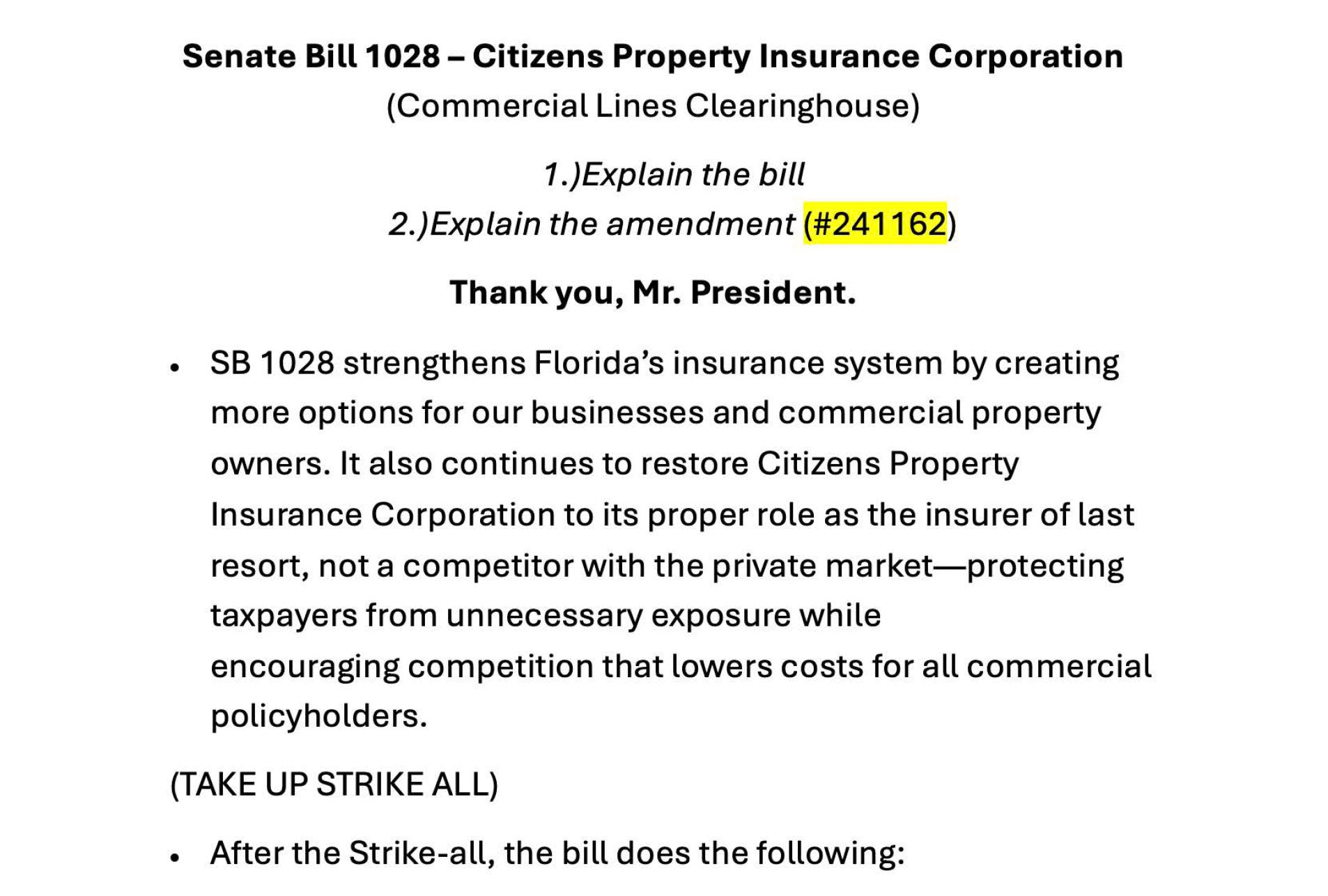
The legislation, Senate Bill 1028, was nominally sponsored by Sen. Joe Gruters, a Republican from Sarasota. But when Gruters presented it on the floor of the Florida Senate, he read nearly verbatim from a script written by Ryan Specialty.
Gruters is not merely a Florida state senator. He is also the chair of the Republican National Committee, a high-profile national post he was installed into last year at the request of President Donald Trump.
And Ryan Specialty is led by one of the largest Republican donors in the country: Pat Ryan, a Chicago insurance magnate with an estimated $8 billion net worth who, along with his wife, has donated more than $50 million to Republican congressional candidates over the past five years, according to federal campaign-finance records.
Ryan Specialty has also become a big political donor in Florida.
Two months before the start of the 2026 session, state records show the company put a combined $750,000 into a pair of political committees controlled by one of its lobbying firms in Tallahassee. They were the first major state-level campaign contributions Ryan Specialty has ever made in Florida.
Would you like to support Seeking Rents without becoming a subscriber? Or are you already a paid subscriber but want to do more to help sustain my work? Click below to make a one-time donation.
Those lobbyist-controlled political committees have in turn cut five- and six-figure checks to key figures across state government — including Gruters and Florida Gov. Ron DeSantis, who signed Senate Bill 1028 into law last month despite others across the insurance industry urging the governor to veto the legislation.
Ryan Specialty did not respond to requests for comment.
Tailor-made legislation
Ryan Specialty began working on Senate Bill 1028 months before the legislation became public.
“Here is the latest draft we discussed,” an aide to Gruters wrote in a Nov. 14 email to a Ryan lobbyist. It is one of dozens of emails, memos, drafts, and other materials related to the legislation that Seeking Rents obtained through a public records request of the Florida Senate.

Though the legislation was still more than a month from being filed — and seven months from becoming law — it already contained many of the core elements of what would become the final product.
Specifically, it required Citizens Property Insurance Corp. to create a new program — called a “clearinghouse” — for surplus lines insurance companies, through which they could submit offers of coverage for condo buildings and other commercial properties that had been unable to find affordable policies on the standard private market and had turned instead to the state’s nonprofit insurer of last resort.
Surplus lines insurers are much different than standard insurance companies like State Farm or Nationwide. Their rates and policy terms do not have to be approved by state regulators, meaning they can charge much higher premiums and the policies they sell often lack basic consumer protections. That’s why surplus lines insurers typically operate in niche markets, covering unusual risks like celebrity body parts or ultra-high-end properties.
The proposed legislation also contained an odd wrinkle: It prohibited Citizens from managing this new surplus lines clearinghouse itself. Instead, the agency would have to hire an outside vendor to run it.
And the vendor requirements were already tailored for Ryan Specialty.
For example, the draft legislation required Citizens to contract with a company that has at least five years of “publicly available” audited financial statements.
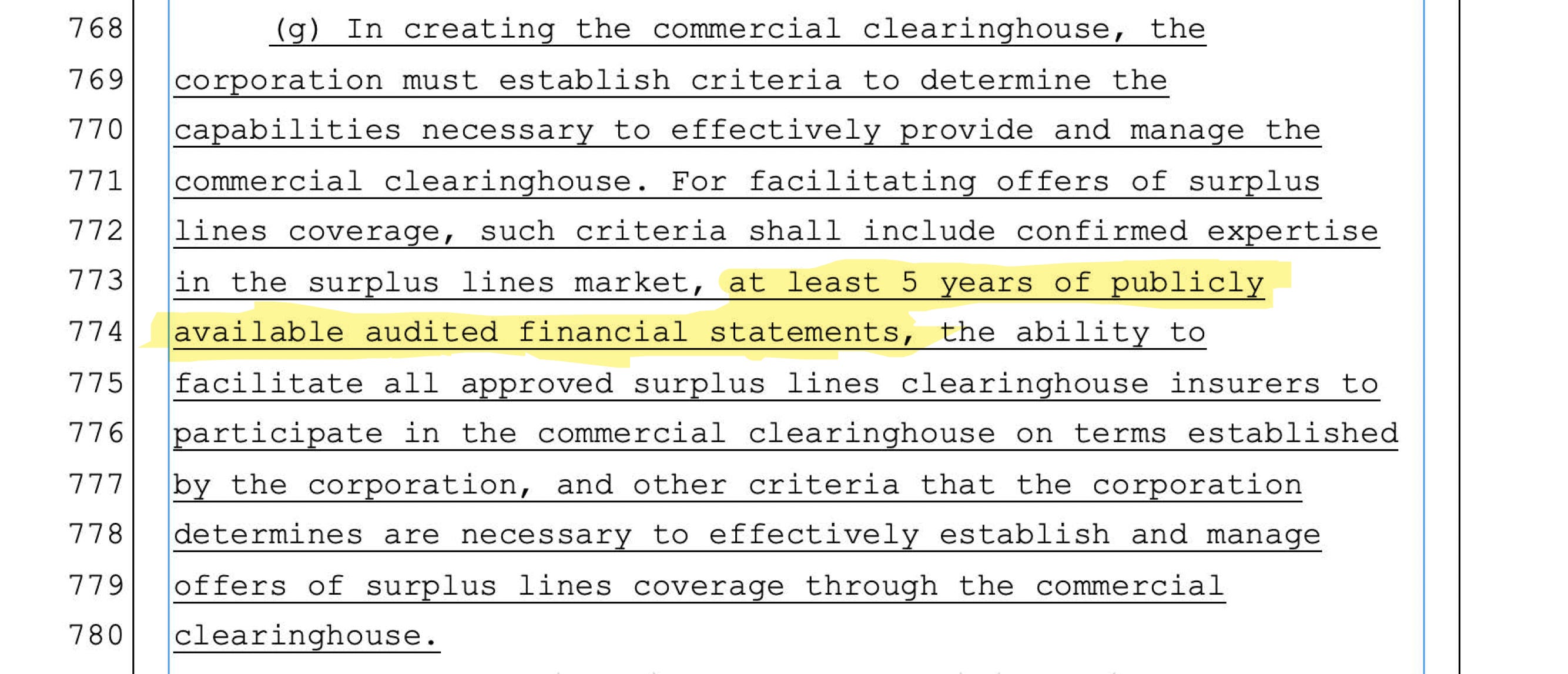
That’s significant because most companies are privately held — and private companies rarely reveal that kind of financial detail to the public.
But publicly traded corporations are required by law to include audited financial statements in annual reports that are available to anyone who wants to read them.
Ryan Specialty went public in July 2021 — exactly five years ago.
Tilting the procurement process further
Once Joe Gruters filed Senate Bill 1028 and the proposal began to move through the Legislature, Ryan Specialty pushed for further changes likely to tilt the procurement process in its favor.
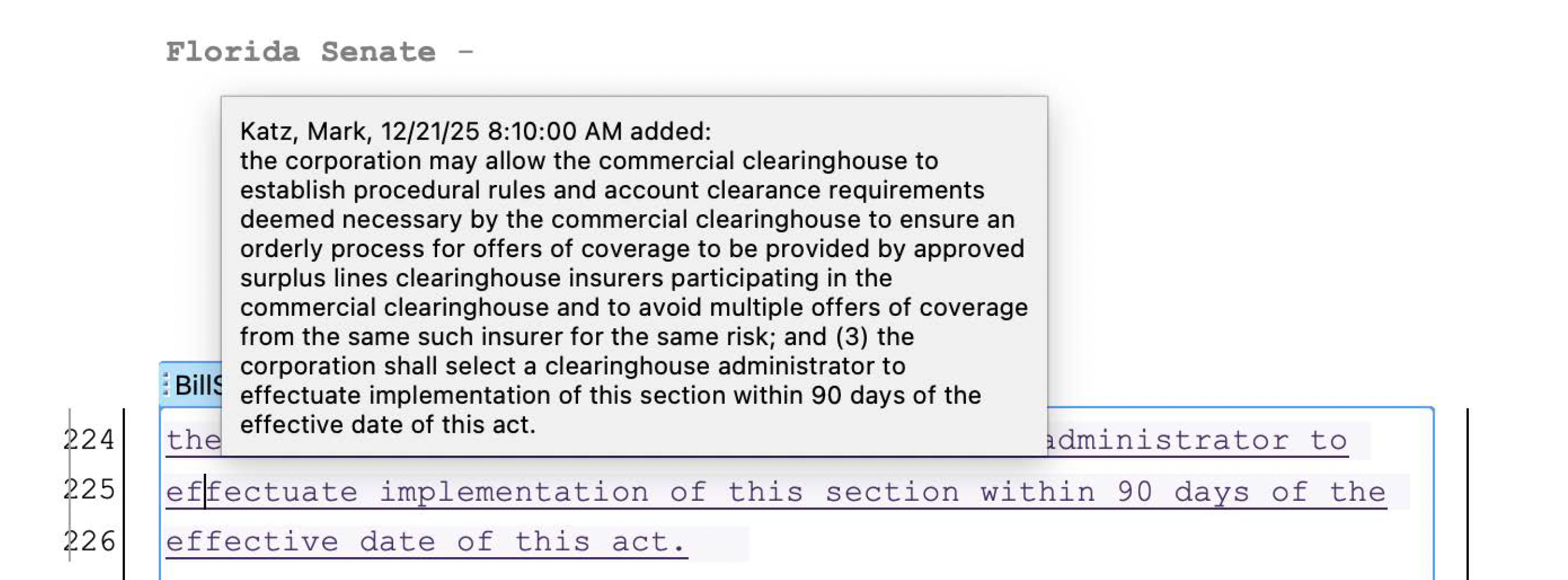
During one committee hearing on the legislation, Gruters filed an amendment that, among other things, ordered Citizens to award the clearinghouse contract very quickly — within 90 days of the bill becoming law.
That idea, bill drafts show, was initially written into the amendment by Mark Katz, an executive vice president and the general counsel at Ryan Specialty.
Why would a fast procurement process favor Ryan? Because the company has already spent many months developing an artificial intelligence-enabled clearinghouse platform to pitch to Citizens Property Insurance. The company dubbed it “The Florida Risk Exchange,” according to a February 2026 report in Insurance Journal, an industry news publication.
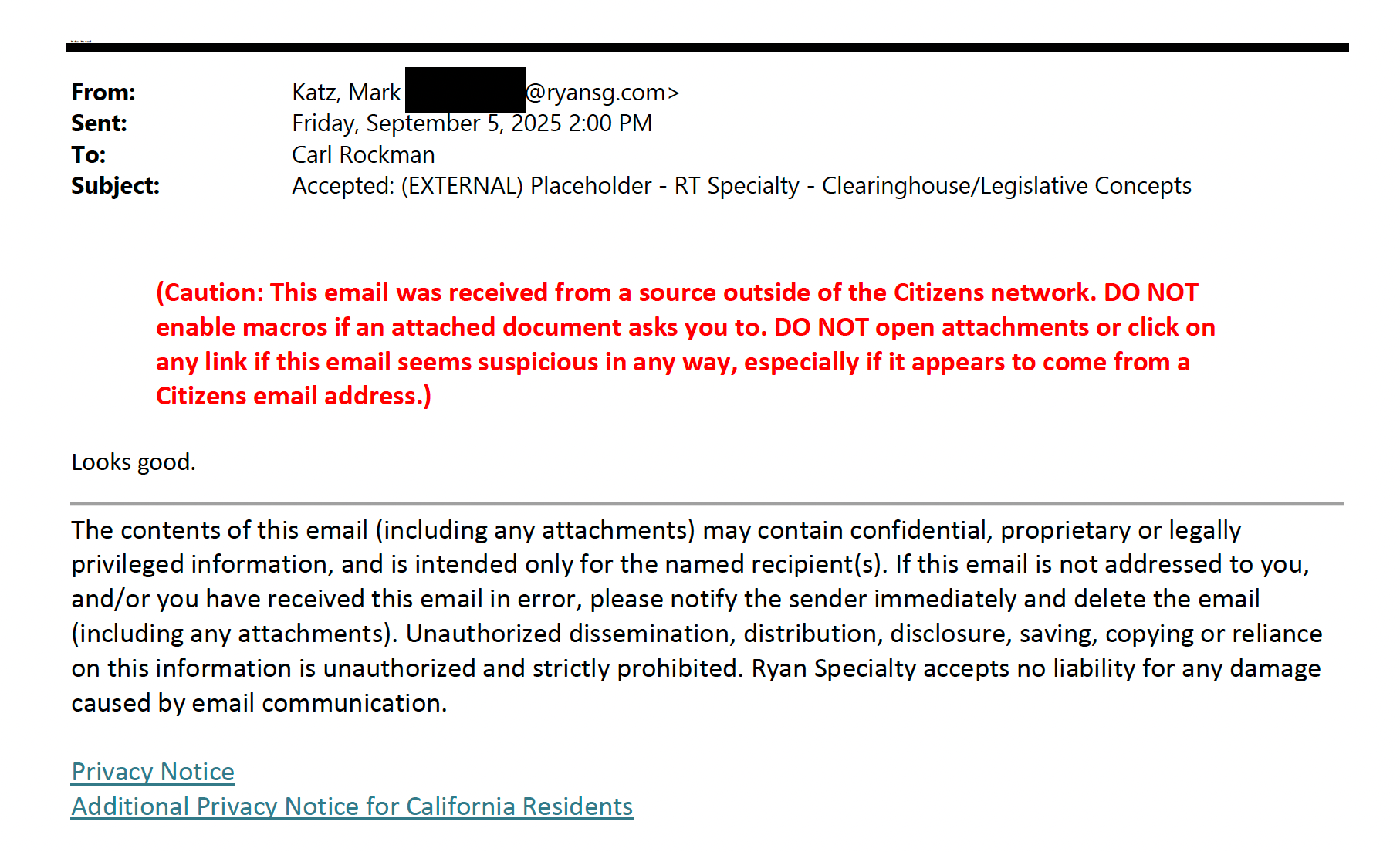
A separate set of records obtained by Seeking Rents — directly from Citizens Property Insurance, rather than the Florida Senate — suggests that Ryan executives were already discussing a clearinghouse proposal with Citizens as early as March 2025.
The records include a March 25, 2025, email in which a manager at Citizens sent a message to an executive at Ryan Specialty referring to “your clearinghouse concept.” The records also include messages scheduling a September 2025 meeting between Citizens and Ryan reps to discuss “Clearinghouse/Legislative concepts.”
Other insurance firms urged legislators to make changes that would have opened up the clearinghouse contract to more potential bidders.
Two Ryan’s top competitors in the surplus lines distribution market — Amwins and CRC Group — specifically requested that the requirement for “publicly available” financial statements be removed from Senate Bill 1028. That’s according to notes that the staff director of the Senate Banking and Insurance Committee wrote into a draft amendment midway through the legislative session.
Amwins and CRC Group are both privately held companies.

Amwins and CRC Group also asked that the 90-day deadline to award the clearinghouse contract be extended or eliminated, the notes show.
Florida lawmakers refused both requests.
A gatekeeper with a conflict of interest
Senate Bill 1028 doesn’t just force Citizens to hire an outside vendor to manage the surplus lines clearinghouse. It also turn that vendor into a powerful gatekeeper.
Under the legislation, a surplus lines insurance company can only participate in the clearinghouse if it is recommended by the vendor managing the program. In other words, that vendor will get to pick and choose which surplus lines insurers are permitted to make offers for Citizens policies.
Records show that’s another idea that came from Ryan Specialty, which had the language added to Senate Bill 1028 via an amendment.
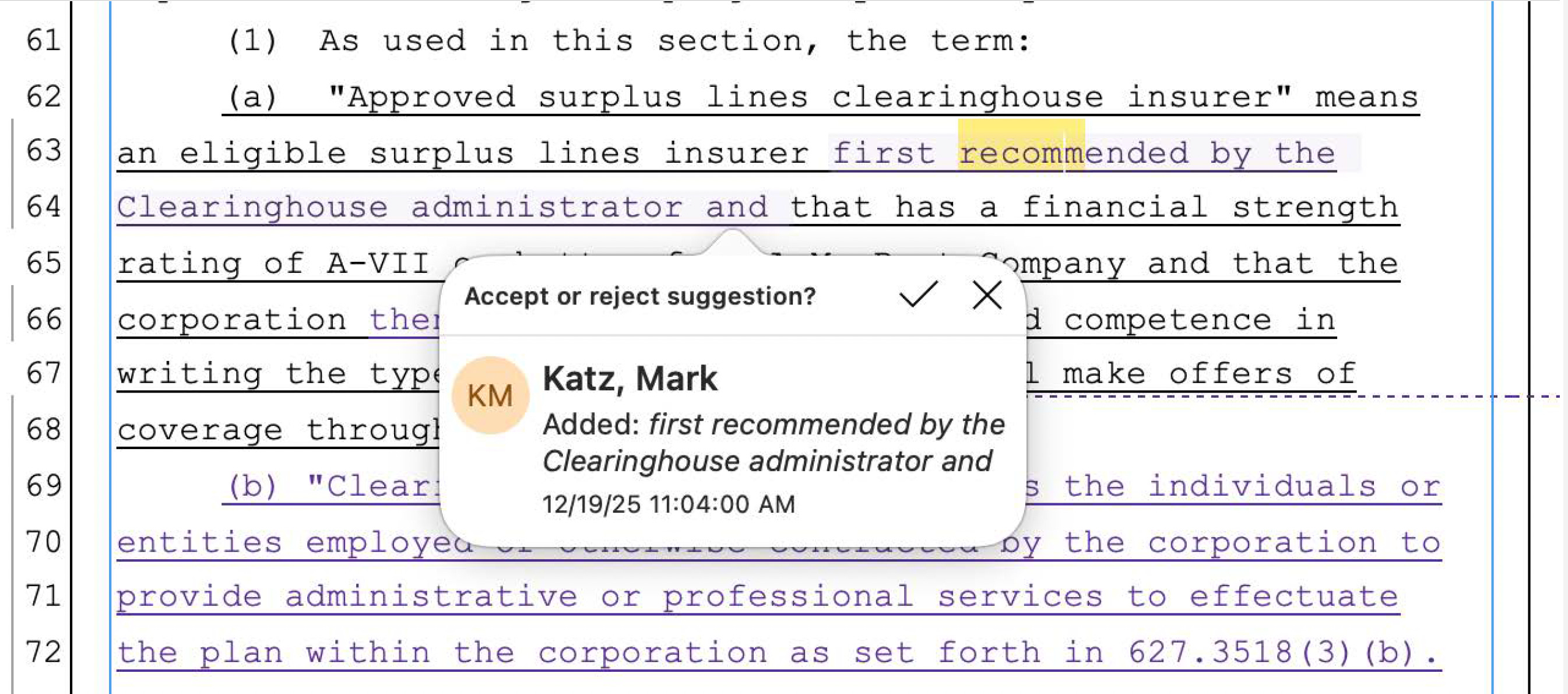
But it also poses an obvious conflict of interest. If a broker that already sells surplus lines insurance itself can also control which surplus lines insurance companies can make offers through the clearinghouse, it could engage in anticompetitive tactics — like steering Citizens policies to its own network of insurers or using the leverage to squeeze extra fees out of unaffiliated companies that want to participate.
In fact, records show that others repeatedly urged lawmakers to ensure open access to the clearinghouse and prevent potential abuses by the company chosen as administrator.
The Florida Association of Insurance Agents, a lobbying group that represents independent agents, asked that Senate Bill 1028 be rewritten “so that the participation is not limited to the brokerage that Citizens procures the clearinghouse from,” according to feedback the organization provided to the Senate.

Meanwhile, the Florida Office of Insurance Regulation — the agency that oversees the insurance industry on behalf of the public — wanted provisions added to the legislation expressly forbidding the vendor hired to run the clearinghouse from “steering” policies to preferred insurers and prohibiting conflicts of interest.
And the staff director of the Senate’s own Banking and Insurance Committee warned Senate leadership about allowing the clearinghouse manager too much discretion. “There should be clear criteria that, if met, allow a surplus lines insurer to participate,” he noted in a draft of a mid-session amendment.
Lawmakers largely ignored the recommendations — at least in part because Ryan lobbied against them.
For instance, after the Florida Association of Insurance Agents provided feedback to the Senate, a lobbyist for Ryan responded with a point-by-point rebuttal. In that document, the company noted that the vendor hired to run the clearinghouse would have to make “a sizable investment” in technology — and suggested that having control over which insurers could participate in the program would help the vendor recoup its investment.
The company also argued that if an agent or policyholder were unhappy with the offer they received through the clearinghouse, they could always go searching for a different offer from some other surplus lines insurer outside the program.
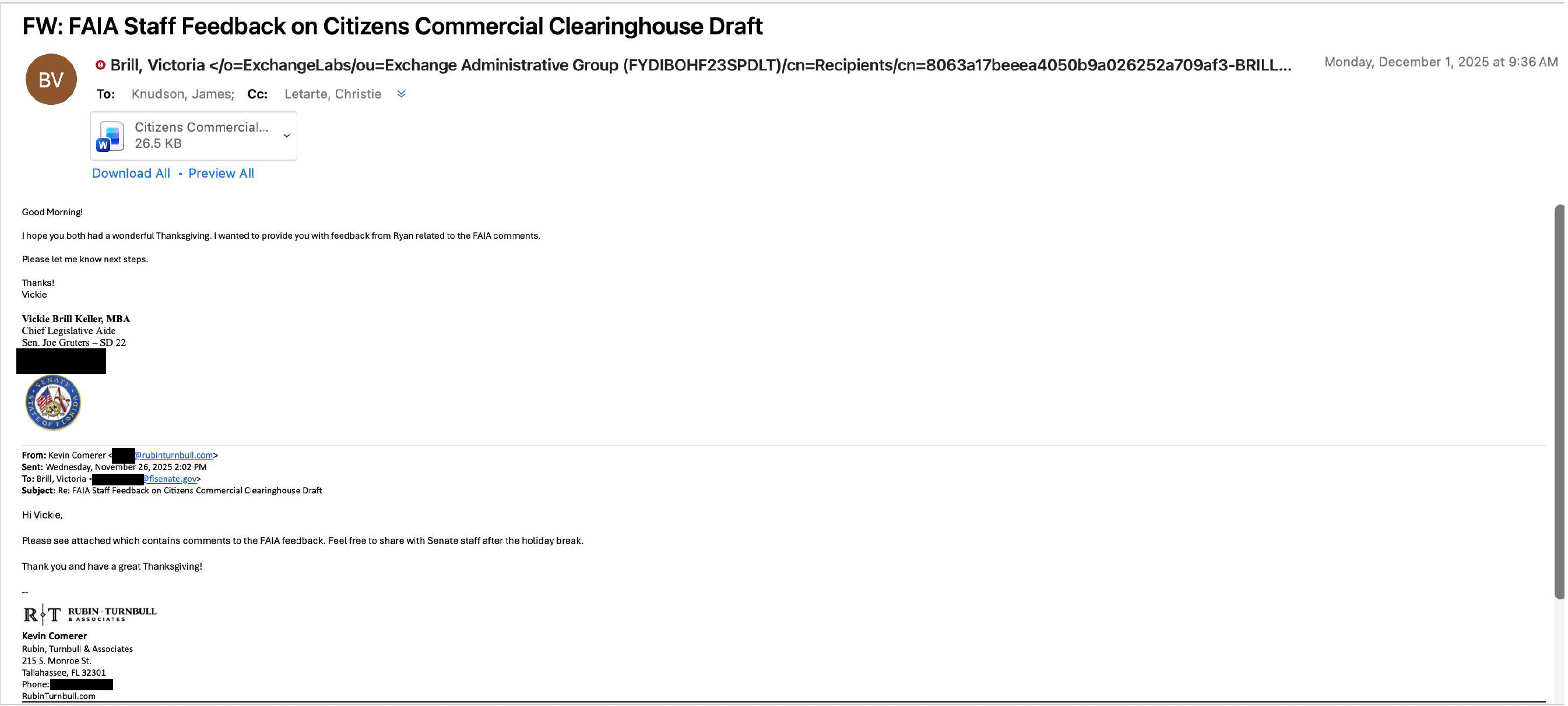
“The clearinghouse is a subset of the surplus lines market,” the company wrote in the document. “Agents can engage surplus lines agents of their choice to market accounts in the surplus lines market outside of the clearinghouse.”
Condo and business owners pay the price
For all the behind-the-scenes battles over issues like procurement, the most salient detail about Senate Bill 1028 — at least if you own a condo or business in Florida — is that it will almost certainly lead to some condo and business owners paying higher prices for their property insurance.
That’s partly because of another provision in the bill that will make a commercial property automatically ineligible for a policy from Citizens if a surplus lines insurer offers coverage through the clearinghouse — even if that surplus lines policy is more expensive.
A condo building, for instance, would only remain eligible for coverage under Citizens if the surplus lines quote is more than 15 percent higher than the price that Citizens would charge. Any offer within that threshold — a concept that insurance lobbyists sometimes call a “strike zone” — would immediately disqualify the property from eligibility for a policy through Citizens.
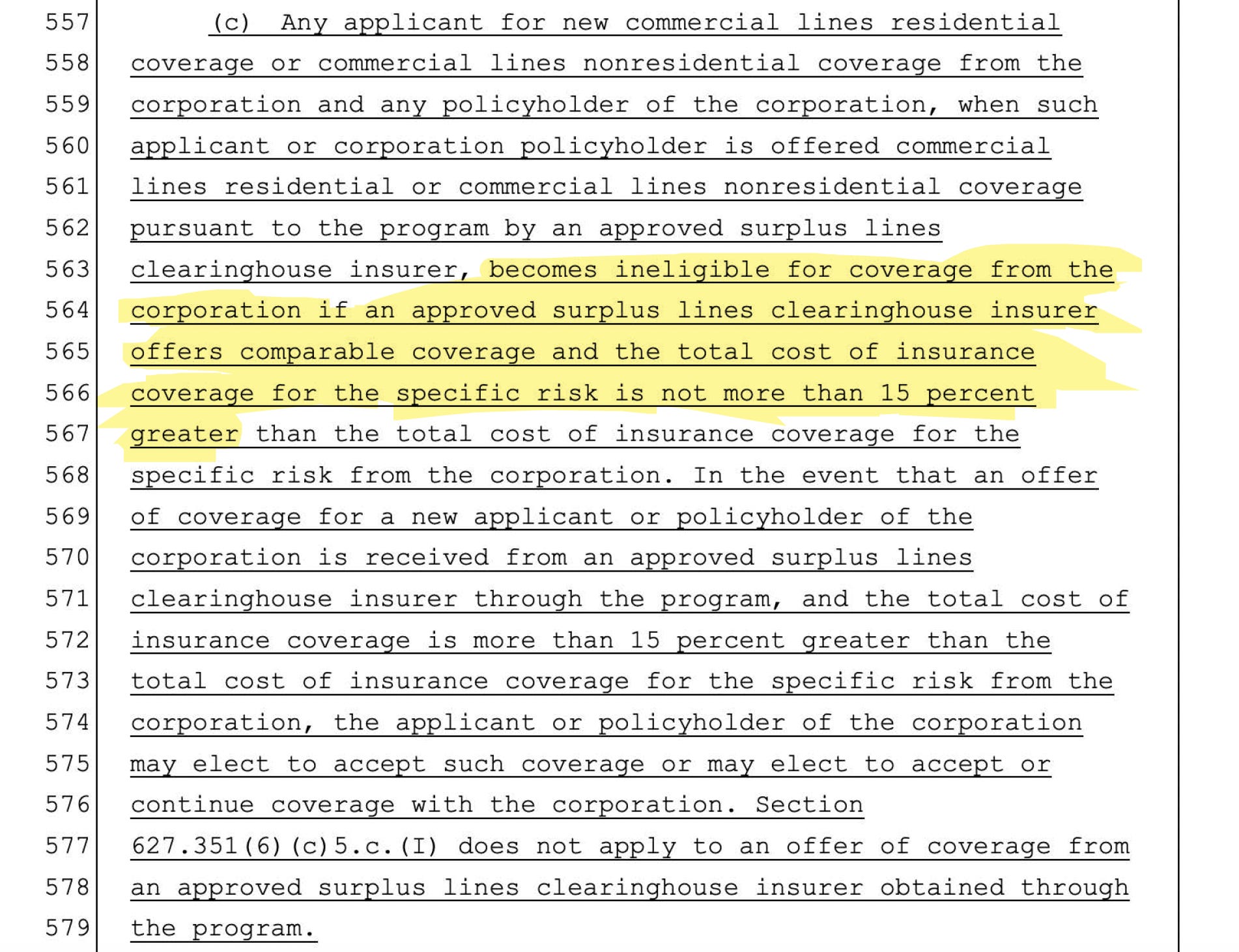
The condo association could still turn down the surplus lines offer. But it would then have to go looking for a private policy somewhere else — without the safety net of Citizens as a backstop.
Records show that insurance agents tried to have that provision removed. They argued that it would inevitably lead to policyholders paying higher prices to a company they never wanted to be in business with in the first place.
“An eligibility terminating offer would often result in the policyholder and agent having to obtain coverage from the surplus lines insurer making the offer,” FAIA said in the feedback it provided to the Senate. “[It] Could result in policyholders and agents having to accept insurance with surplus lines carriers they may not want to be in business with.”
But Ryan’s lobbyists again insisted on keeping automatic termination in the bill.
“The surplus lines insurers participating in the clearinghouse would be AM Best rated A-VII or better and would have to meet market security standards, which should alleviate agent concerns about ‘having to accept insurance with surplus lines carriers they may not want to be in business with,’” the company wrote in a document provided to the Senate in response to FAIA’s feedback.
What’s more, the records show Ryan also pushed to make the “strike zone” wider.
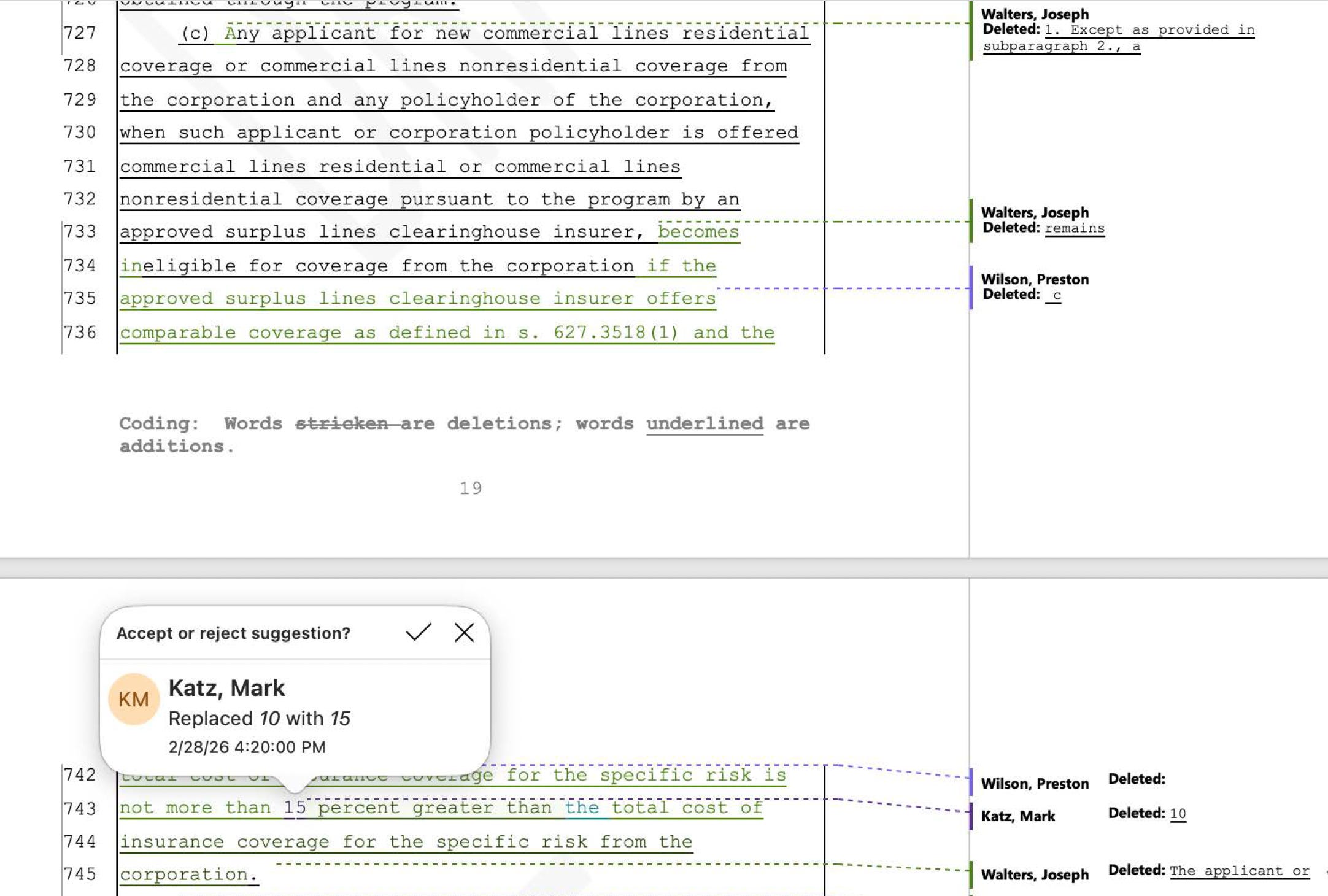
For instance, the early draft of the bill — the one that Ryan Specialty was working on with Joe Gruters back in mid-November — would have forced policyholders out of Citizens if they received a surplus lines offer that was up to 20 percent more expensive.
Later in session, the Office of Insurance Regulation pushed to lower the threshold to 10 percent.
But Ryan Specialty executives then lobbied it back up to 15 percent, according to drafts exchanged during some of the late-session negotiations on Senate Bill 1028.
Modest changes fail to mollify opponents
Lawmakers did make some changes to Senate Bill 1028 before it finally passed on a 33-1 vote in the Senate and an 88-19 vote in the House of Representatives.
They agreed, for instance, to give the Office of Insurance Regulation more oversight over the clearinghouse than the proposal originally envisioned — despite apparent opposition from Ryan, whose lobbyists argued that surplus lines insurers “will refuse to participate” if they face too much scrutiny from regulators.
Lawmakers also required Citizens to set up a second clearinghouse for commercial properties — one that will essentially require the agency to shop policies one more time with standard insurance companies before they are put through the the surplus lines clearinghouse.
Would you like to support Seeking Rents without becoming a subscriber? Or are you already a paid subscriber but want to do more to help sustain my work? Click below to make a one-time donation.
But the modest changes failed to mollify opponents, who still warn that Senate Bill 1028 may end up enriching Ryan Specialty at the expense of condo and business owners across the state.
A trade group representing the surplus lines insurance industry itself even came out against the bill after the session ended. But Florida Gov. Ron DeSantis approved it anyway, signing the legislation with little fanfare on June 16.
Citizens is now racing to award the contract.

More awesome investigative reporting Jason!
I honestly don't believe that a single one of these Republicans writes any of their legislation, let alone even reads it. It appears that every last one of them is just a bought and owned proxy hack for corporate America, the Chamber of Commerce, ALEC, and anyone else willing to shower them with legalized bribes.
“The surplus lines insurers participating in the clearinghouse would be AM Best rated A-VII or better and would have to meet market security standards, which should alleviate agent concerns about ‘having to accept insurance with surplus lines carriers they may not want to be in business with,’”
I can readily agree that the financial stability of an insurer is important when looking for insurance. But just like price alone shouldn’t be the sole criterion, neither is financial stability. Aspects of an insurer’s business, such as adjustment procedures, customer service, agent network, and likely other practices that I don’t know can be just as important in choosing an insurer. And if surplus lines insurance is less regulated, then the insured needs more information, not less, when looking for insurance. Reducing the decision to one item smacks more of abusive lending and sales practices commonly seen 60 years ago.