

This is Seeking Rents, a newsletter and podcast devoted to producing independent journalism about Florida politics, with an emphasis on the ways that big businesses and other special interests influence public policy in the state. Seeking Rents is produced by veteran investigative journalist Jason Garcia, and it is free to all. But you can support my work by becoming a paid subscriber and/or by making a one-time donation.
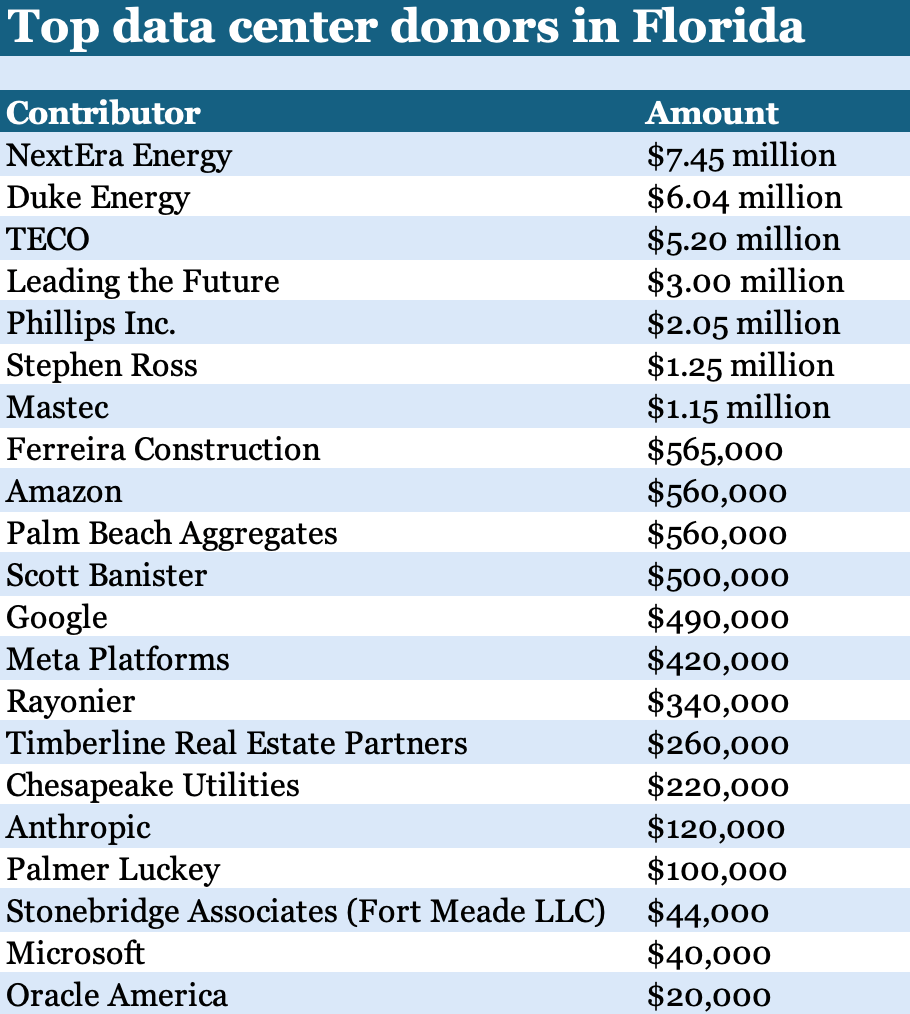
Data center supporters have poured more than $30 million into the race for governor and other campaigns across Florida, according to an updated Seeking Rents analysis.
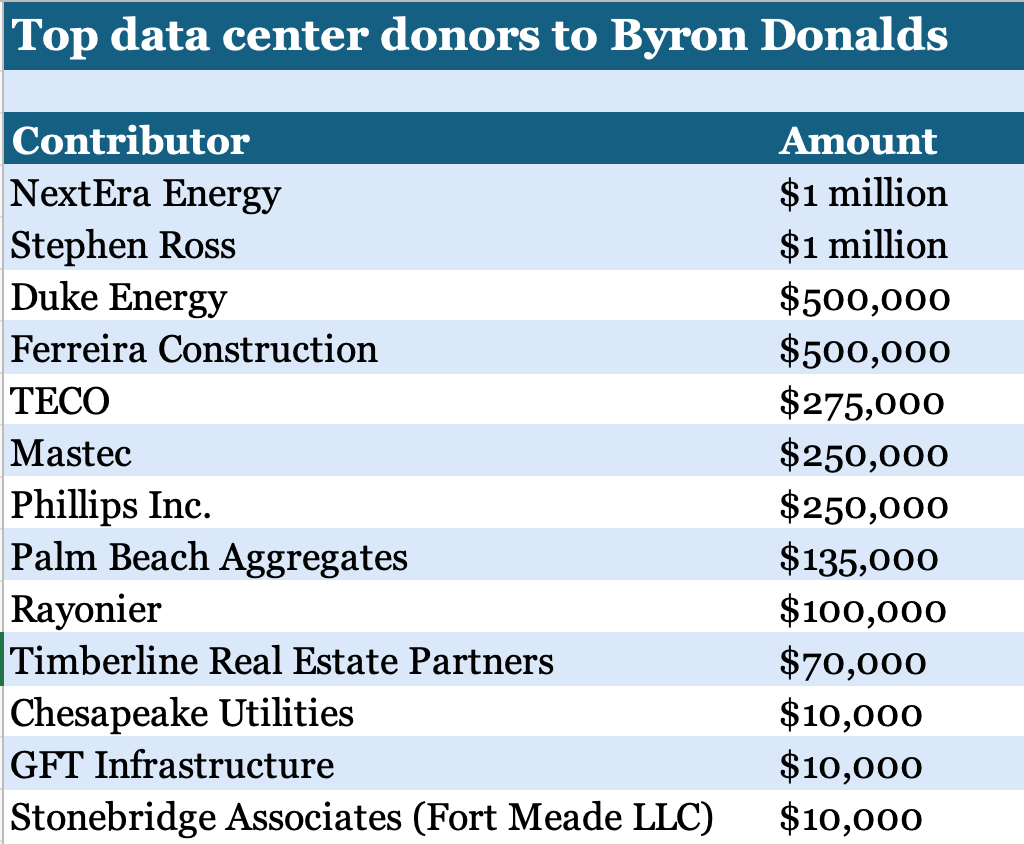
The industry’s favorite Florida candidate remains Byron Donalds, the Republican gubernatorial nominee whose campaign has been powered in part by more than $6 million in direct donations and advertising support from data center boosters — a collection of special interests that includes Florida’s major electric utilities, Big Tech firms like Meta and Google, billionaire artificial intelligence investors, and real-estate developers pursuing data center projects.
Data centers have become one of the brightest dividing lines in the race to succeed outgoing Gov. Ron DeSantis. The contest pits Donalds, a member of Congress from Naples who won the GOP nomination thanks in large part to an endorsement from President Donald Trump, against Democratic nominee David Jolly, a former member of Congress from near St. Petersburg and a one-time Republican who left the party early in the Trump era.
Donalds has said he supports some data center development. Jolly says he would impose a year-long moratorium on all data center construction.
But data center interests are also spending big further down the ballot — particularly in an effort to help the Republican Party retain its supermajorities in the state Legislature. AI and data center regulations will be a top issue during the state’s 2027 legislative session.
After Donalds, the No. 2 recipient of industry contributions is the Florida Republican Senatorial Campaign Committee. That’s a leadership fund led by incoming Senate President Jim Boyd (R-Bradenton). It is financing multimillion-dollar advertising blitzes promoting the GOP candidates, and attacking the Democratic alternatives, in key Senate battleground races.
The most intensely fought races include District 10 in Orlando, where Republican Sen. Jason Brodeur is being challenged by Democrat John Lowndes, the mayor of Maitland; District 14 in Tampa, where Republican Josie Tomkow, a former state representative, is facing off against Democratic Sen. Brian Nathan in a rematch of a special election held earlier this year; and District 38 in Miami, where Republican Sen. Alexis Calatayud of Miami is trying to fend off Democratic entrepreneur Richard Lamondin Jr.
Altogether, the Seeking Rents analysis finds that data center interests have spent more than $11 million on Republican legislative campaigns. The total includes $2.5 million to the Florida House Republican Campaign Committee, which is led by incoming House Speaker Sam Garrison (R-Fleming Island) and is advertising in swing House seats. It also includes millions more donated directly to GOP legislators and legislative candidates.
The industry has put just over $1.3 million into Democratic legislative campaigns.
Democrats would need to gain one seat in the 40-member Florida Senate and seven in the 120-member House of Representatives to break the GOP supermajorities.

Among data center donors, the biggest by far are Florida’s three corporate utility companies: NextEra Energy, the parent company of Florida Power & Light; Duke Energy; and TECO Energy.
All three utility companies — which sell the electricity that data centers consume — are pursuing large-scale projects in their territories; NextEra’s top executive recently told investors that the company expects to announce a major data center development in Florida within the next three months.
“We feel bullish about large load opportunities in Florida,” NextEra President, CEO and Chairman John Ketchum said at an Oct. 1 energy conference in New York. “We’ll announce something by the end of the year on that front.”
AI investors and tech giants are also spending lavishly on state elections.
For example, a political committee called American Mission Florida paid for more than $2 million of advertising supporting Donalds during the Republican primary for governor. American Mission Florida is funded entirely by a federal Super PAC called Leading the Future that is itself funded primarily by billionaire investors in OpenAI, the company behind ChatGPT.
More recently, American Mission Florida gave a combined $75,000 to Garrison, the incoming House speaker, and Boyd, the incoming Senate president.
Meanwhile, records show that another Silicon Valley tycoon — Scott Banister, an Elon Musk contemporary who was an early investor in PayPal and SpaceX — is financing at least half a million dollars’ worth of digital ads attacking Democratic candidates in two dozen legislative races around the state. Those particular ads are being sponsored through a political committee called First Amendment LLC.
Banister is a partner at a venture capital firm called Long Journey, whose portfolio includes an assortment of AI and data center infrastructure firms — and Flock Safety, the surveillance camera company.
Big Tech firms Amazon, Google and Meta have all donated more than $400,000 each to various candidates, committees and parties in Florida — with Google and Meta significantly ramping up their spending over the past three months.
Meta, the parent company of Facebook and Instagram, also stands out for directly intervening in select primary elections.
For instance, a company-created political committee spent more than $200,000 to help Democratic state Rep. Fentrice Driskell of Tampa win the Democratic nomination for an open Senate seat in the Tampa Bay area. Driskell faces no general election opponent in Senate District 16 — which, like most Senate and House seats across Florida, has been intentionally gerrymandered to avoid general election competition.
Would you like to support Seeking Rents without becoming a subscriber?
Already a paid subscriber but want to do more to help sustain my work?
Click below to make a one-time donation.
A few important points to keep in mind about this analysis.
First, direct donations don’t represent all the money a candidate may have taken from data center interests. That’s because the industry has also put more than $6 million into political committees controlled by Associated Industries of Florida and the Florida Chamber of Commerce, the state’s two main Big Business lobbying groups,
Those AIF and Chamber political committees are in turn making their own campaign contributions — mostly, though not exclusively, to Republicans. Donalds, for instance, has received more than $3.5 million from AIF and Chamber committees.
Second, $30 million almost certainly understates the industry’s total spending on Florida elections. The reason: The state political parties — including the Florida Republican Senatorial Campaign Committee and the Florida House Republican Campaign Committee, as well the corresponding Democratic leadership funds — haven’t had to disclose any of their donors since Aug. 14, just a few days before the primary election.
The parties won’t have to reveal the full scope of their general election fundraising until Oct. 30. — less than a week before Election Day.
Finally, I went through a detailed explanation of who I count as a “data center supporter” — and why — when Seeking Rents reported over the summer that the industry had already spent more than $20 million on state elections. You can read that piece here.

But I’ve also added a few new names to the list who weren’t included in those pre-primary calculations.
The two big examples are Stephen Ross, the billionaire real-estate developer and owner of the Miami Dolphins football team, and Mastec, the infrastructure construction firm whose billionaire chairman, Jorge Mas, owns the Inter Miami soccer team.
Ross is the founder and chairman of Related Companies, which has a division devoted to data center development. Related Digital is currently partnering with NextEra Energy to develop a $22 billion data center campus in Texas known as “Project Star.”
MasTec, meanwhile, has made serving data center construction a key strategic focus. Company leaders are even engaging on lobbying on data center policy.
“I think there’s lots of parts of the county where communities are embracing data centers,” MasTec CEO Jose Mas told investors during a quarterly earnings call in July. “We’re engaged in lots of governmental affairs, conversations across multiple states, where they’re actually looking to expand and bring data centers in they currently don’t have, which I think creates some great opportunities for us.”

Our water in Florida is finite! Restricted to rainfall and any other replenishment. Our springs are not bubbling anymore due to LACK OF WATER in the aquifer ! Our farms and houses are dependent on that aquifer. Where will those data centers get the maximum amounts of water they require?!?! Please do NOT ALLOW this to bury living in Florida.
Data centers, water bottlers taking up to 1 million gallons a day from north Florida springs the bad news never ends,
But we have a chance to vote BLUE and possibly change the downward slide