
Developer lobbyists secretly sought to maintain a law handcuffing local communities on growth
Records show lobbyists representing Sarasota homebuilders Pat Neal and Carlos Beruff objected to legislation to fix Senate Bill 180, which has undermined growth-management laws around Florida.


This is Seeking Rents, a newsletter and podcast devoted to producing independent journalism about Florida politics, with an emphasis on the ways that big businesses and other special interests influence public policy in the state. Seeking Rents is produced by veteran investigative journalist Jason Garcia, and it is free to all. But you can support my work by becoming a paid subscriber and/or by making a one-time donation.
Lobbyists representing a pair of prominent homebuilders in Sarasota — both major donors to Republican leaders in Tallahassee — secretly worked to stop state lawmakers from repealing a widely reviled law that has made it much harder for communities across Florida to manage growth.
Records obtained by Seeking Rents show that lobbyists whose clients include Pat Neal of Neal Communities and Carlos Beruff of Medallion Home arranged a private meeting with at least one top lawmaker during this year’s legislative session to object to a bipartisan plan to undo parts of a law known as Senate Bill 180.
Senate Bill 180 was a piece of legislation passed in 2025, ostensibly to help with hurricane recovery, that supporters said was intended to stop local governments from interfering with Floridians trying to rebuild homes and businesses damaged during a big storm. But the year-old law has been weaponized by developers, who have used it to stop cities, counties and towns from protecting wetlands, preserving rural areas, reducing flooding or anything else that could be considered “burdensome” to builders.
The hurricane-recovery law has even complicated local efforts to slow or stop development of hyperscale data centers.
Legislation to fix Senate Bill 180 ultimately failed to pass during the 2026 legislative session, which ran from January to March. But not because lawmakers voted against it — because some of them ducked the vote entirely.
Twice during the closing days of session, Republican leaders in the state House of Representatives manipulated procedural rules to block a vote on repealing Senate Bill 180 — something that may well have passed had House members been forced to take a public position on it.
A week after the session ended, records show that Pat Neal made a $25,000 donation to Rep. Sam Garrison, a Republican from Fleming Island who chairs the House Rules & Ethics Committee — and who single-handedly stopped the votes from happening.
Two months later, Neal gave Garrison another $50,000.
Would you like to support Seeking Rents without becoming a subscriber?
Already a paid subscriber but want to do more to help sustain my work?
Click below to make a one-time donation.
If ever a bill seemed a good bet to pass, it was Senate Bill 840.
Filed a month before the start of the 2026 session, the legislation was designed to roll back the parts of Senate Bill 180 that have completely handcuffed local governments — by imposing what is essentially a multi-year, statewide moratorium on any land-use or development rules that can be considered “more restrictive or burdensome” than the status quo.
Senate Bill 180 led to legal chaos that continues to this day — as well as lots of angry constituents, many of whom have made their displeasure known to their elected representatives in Tallahassee.
“When I was campaigning, probably the bill that people complained about most to me — mainly because of their misunderstanding of its intent — was Senate Bill 180,” Sen. Ralph Massullo, a Republican from Lecanto who won a December 2025 special election to the Senate, said during a committee hearing on Senate Bill 840.

Senate Bill 840 was even sponsored by the same legislator who carried Senate Bill 180: Sen. Nick DiCeglie (R-Indian Rocks Beach), who has acknowledged that his 2025 law had “unintended consequences” that “paralyzed” local communities.
And indeed, as soon as the 2026 session gaveled opened, Senate Bill 840 began flying through the Florida Senate. It cleared every committee and the full chamber within a matter of weeks, by unanimous votes every step of the way. Not a single person or interest group said a single word opposing the bill.
At least not in public.
Behind the scenes, though, at least two lobbyists were working to slow or stop the legislation.
A string of emails obtained by Seeking Rents through a post-session public records request show that the lobbyists — Chris Schoonover of the firm Capital City Consulting and Jeff Woodburn of The Advocacy Partners — arranged a meeting with Sen. Kathleen Passidomo (R-Naples) to raise objections to Senate Bill 840.
A former Senate president, Passidomo spent the past two sessions as the chair of the powerful Senate Rules Committee. She also served on the Senate Judiciary Committee. Senate Bill 840 needed to pass through both.
“I spoke briefly with President Passidomo this morning so all good for the committee hearing tomorrow,” Schoonover wrote in a Jan. 19 email to one of Passidomo’s aides, one day before the Judiciary Committee hearing. “But myself and Jeff Woodburn would still appreciate some of her time to walk through the bill and concerns we have prior it to being heard in its next and final stop Rules.”
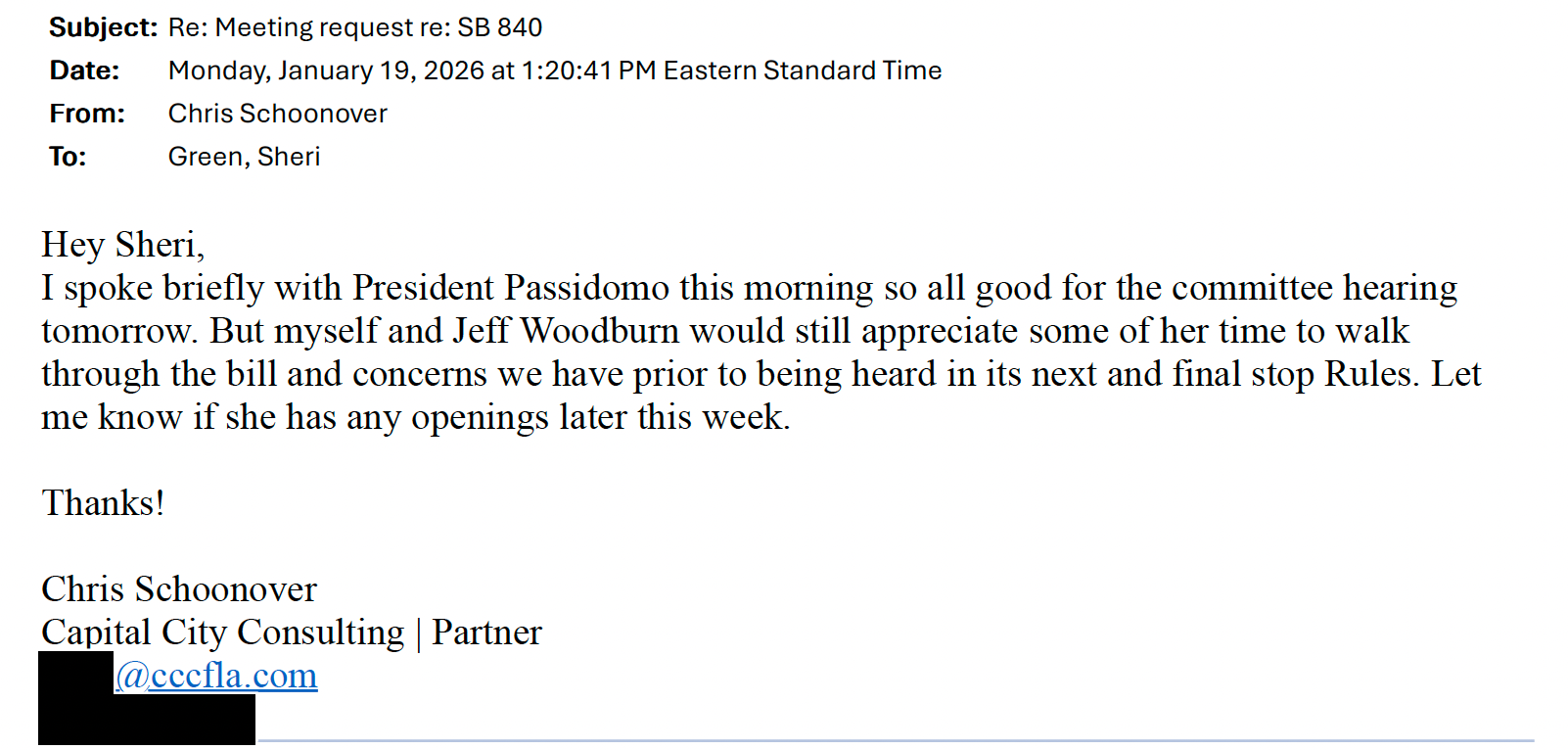
The lobbyists didn’t identify their specific clients in the emails. Nor did they respond to questions from Seeking Rents asking who they were representing on Senate Bill 840 or what their specific concerns were.
But Capital City Consulting’s client list includes Pat Neal. The Advocacy Partners represents Carlos Beruff. And few developers have wielded Senate Bill 180 more aggressively than the two Sarasota-based builders.
For instance, Neal and one of Beruff’s companies are lead plaintiffs in a lawsuit using Senate Bill 180 to stop Manatee County from raising impact fees on homebuilders.
The year-long litigation has effectively frozen more than $14 million in public funds that the fast-growing county would otherwise spend improving traffic congestion, expanding parks, adding police officers and building libraries, according to The Bradenton Herald.

What’s more, one of the earliest impacts of Senate Bill 180 was to stop Manatee County commissioners from restoring a popular local ordinance requiring developers to preserve larger buffers between new construction and environmentally sensitive wetlands. Neal and Beruff had both previously opposed the wetlands ordinance, which had been repealed by a previous iteration of the county commission that was more aligned with the developer lobby.
Neither Neal nor Beruff responded to requests for comment.
Other developers were almost certainly lobbying against Senate Bill 840, as well.
Another email in the string, for instance, suggests that a lobbyist at the firm Stearns Weaver Miller was also working against the legislation. The firm lobbies the Florida Legislature on behalf of a number of development clients, including a company run by John Falkner, a large developer and landowner in Manatee County.
Stearns Weaver Miller lobbyists were also involved with another controversial development law: Senate Bill 686, known as the “agricultural enclaves” bill, which went into effect last month and already has more than 15 square miles of agricultural land around Florida at risk of being consumed for new housing subdivisions

For her part, Passidomo said she couldn’t recall what concerns the lobbyists discussed with her. And whatever they were, they didn’t have much impact in the Senate: Passidomo’s Rules Committee and the Legislature’s entire upper chamber ultimately passed Senate Bill 840 without any changes or amendments.
“I supported the bill and was disappointed that it didn’t get heard in the House,” Passidomo said.
The development lobby is thrilled, though.
While no one was willing to publicly oppose Senate Bill 840 during session, several organizations have since celebrated its demise.
The Florida Home Builders Association now claims credit for “protecting key policies like Senate Bill 180” during the 2026 session. Neal Communities is a member of the organization.
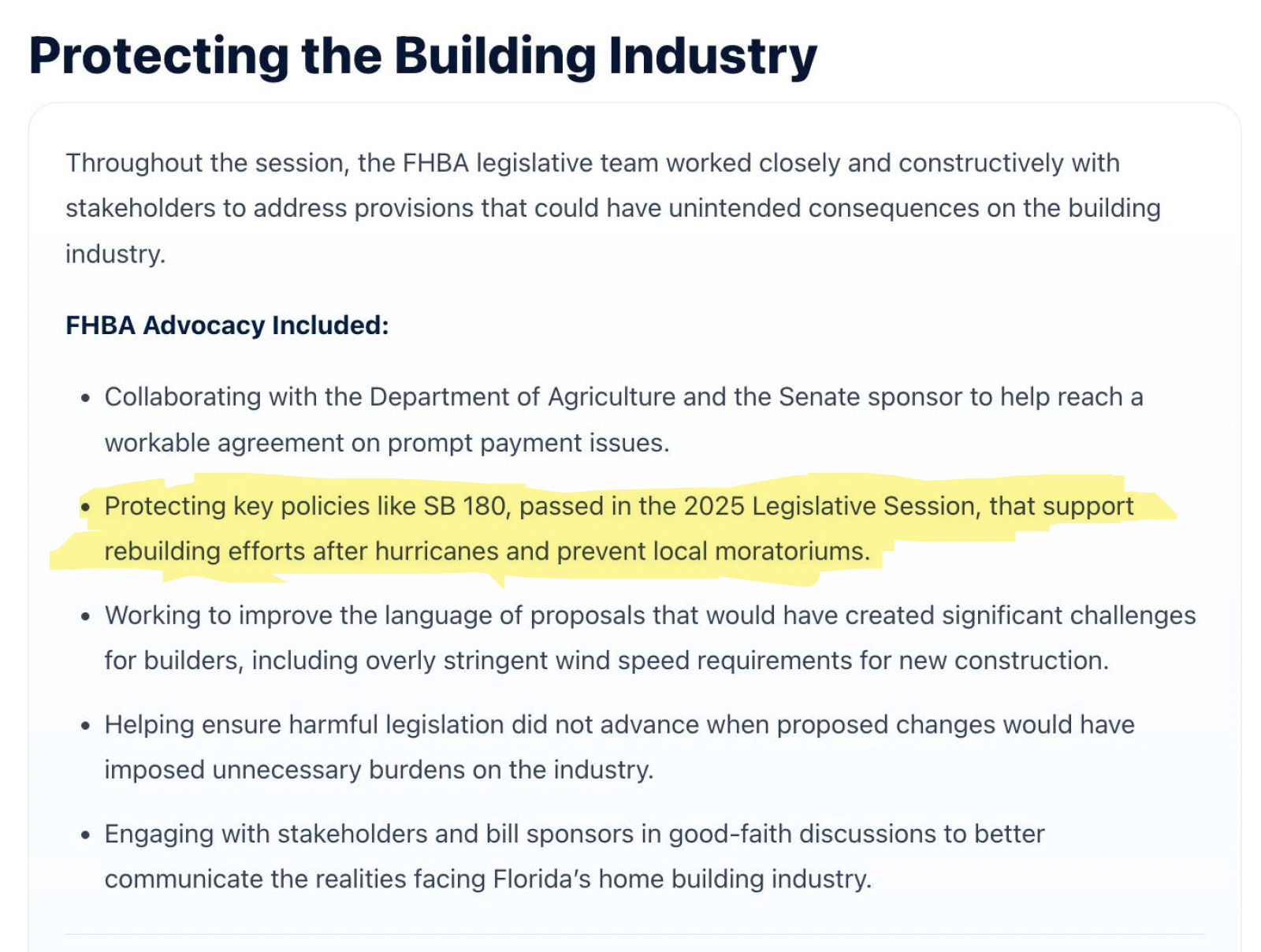
Another big business front group — Associated Industries of Florida, a leading supporter of hypersale data centers — has also reveled in maintaining what it calls the “important provisions passed in SB 180.”

Excellent article. Well - we get what we elect and when state politicians like Senator Passidomo and others represent special interests over voters, it’s time for voters to start voting differently. Senator Passidomo got the ball rolling with this with 180 - with punitive legislation aimed directly at Naples….then it spread. This more than anything, will be her legacy.
What’s funny is publicly every lawmaker is jumping on the “over crowded, over developed” Florida bandwagon. Until it’s time to pass legislation to address it.
For now, they get to have and eat their cake. We need to find ways to get them to regret that third piece of cake.