

This is Seeking Rents, a newsletter and podcast devoted to producing original journalism — and lifting up the work of others — about Florida politics, with an emphasis on the ways that big businesses and other special interests influence public policy in the state. Seeking Rents is produced by veteran investigative journalist Jason Garcia, and it is free to all. But please consider a voluntary paid subscription, if you can afford one, to help support our work. And check out our video channel, too.
The state of Florida is launching a controversial new college oversight board using $4 million of taxpayer money that Republican leaders snuck into the state budget under misleading pretenses.
The hidden earmark was slipped into the state spending plan by a former Republican state House speaker who later tried and failed to get himself picked as president of the University of Florida.
And it has enabled Gov. Ron DeSantis — who has made it a years-long mission to expand state control of university campuses — to move quickly ahead with a new plan to take over college accreditation, too.
This involves one of those super-wonky — but critically important — subjects.
Accreditation is essentially the licensing system for American universities — a system meant to ensure colleges are delivering high-quality education to their students while helping families distinguish between trustworthy institutions and diploma mills.
Accrediting agencies set minimum standards around things like educational quality and academic freedom that schools must adhere to. They can investigate their member schools, sanction those that violate the standards, and revoke accreditation altogether.
Accreditors also have enormous enforcement power, because a university must be accredited in order to qualify for billions of dollars in federally funded student financial aid. Even the mere suggestion that a school’s accreditation might be at risk — like when an accrediting agency opens an investigation into potential infractions — can do substantial damage. The loss of accreditation is often called a “death sentence” for a university.
And accreditors are independent. While an accrediting agency must win initial approval from the federal government before it can begin licensing schools, it otherwise operates relatively free from interference from Washington or any state capital. That helps insulate the agencies — and, by extension, their universities — from excessive influence from politicians and donors.
But this system has become a rising source of frustration on the American right, particularly among conservative thought leaders and Republican politicians who have long complained that college campuses are too liberal — but have had some of their attempts to forcibly wrench schools rightward thwarted by accreditors.
In Florida, for instance, the DeSantis administration has repeatedly clashed with the Southern Association of Colleges and Schools Commission on Colleges, or SACSCOC, the primary accreditor in the southeastern United States.
This is why it was so significant when Ron DeSantis announced last month that Florida and five other southern states would seek permission from the Trump administration to create their own higher education accreditor.
They’re calling it the “Commission for Public Higher Education,” and it would, ultimately, be controlled by state politicians. And it could be used as a means for Republican-controlled states to evade truly independent accreditation.

In addition to Florida, the founding states include Georgia, North Carolina, South Carolina, Texas and Tennessee. The governor of Louisiana has since said his state will join the project, too.
Starting a new college accreditor from scratch isn’t cheap. But shortly after DeSantis announced the plan, Florida’s Board of Governors — the governor-appointed body that oversees the state university system — revealed that it had been sitting on $4 million for nearly a year that it is now using to cover start-up costs.
The money, records show, had been deliberately hidden from the public until that point.
The earmark was buried deep inside last year’s state budget — so deep that it isn’t actually mentioned anywhere in the 523-page spending plan that Florida’s Republican-controlled Legislature approved back in March 2024. It only briefly surfaced in a few obscure appropriations records, under a line item that was so vague — “implementation expense” — it was meaningless.
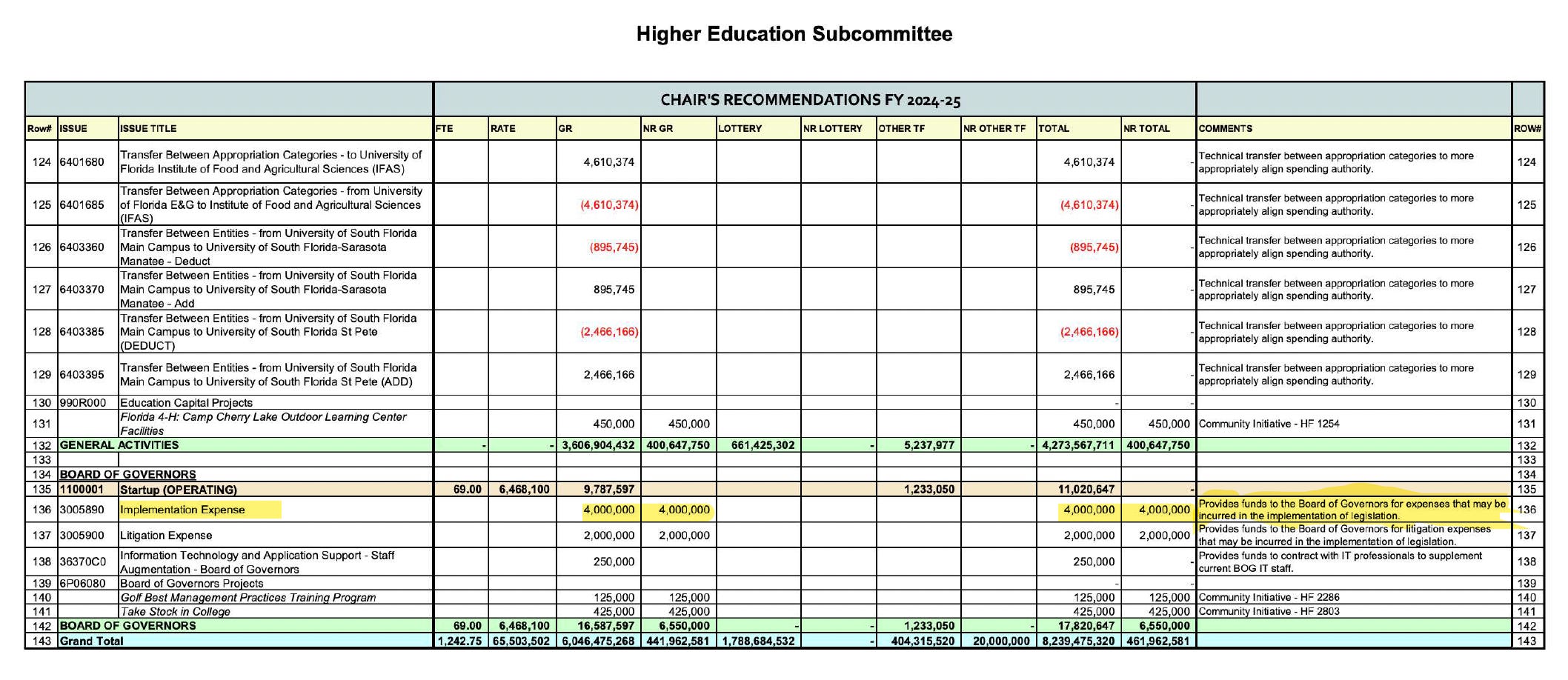
The sole public explanation for the $4 million can be found in line 136 of a small-font spreadsheet that Florida lawmakers blitzed through during a five-minute budget hearing in January 2024.
But even then, there was no mention of Florida creating its own college accreditor. Such a proposal would have drawn immediate national scrutiny — especially since the DeSantis administration had just recently filed a high-profile federal lawsuit seeking to have the entire accreditation system declared unconstitutional.
Instead, Republican leaders in the Florida House of Representatives merely labeled the money as being for “for expenses that may be incurred in the implementation of legislation.”
But while no one in Tallahassee said anything publicly at the time, the money was set aside specifically for the accreditor project, according to Ray Rodrigues, the chancellor of Florida’s state university system.
Rodrigues said the money was put into the budget by then-House Speaker Paul Renner, a Republican from near Jacksonville who later tried — and failed — to get himself appointed president of the University of Florida. DeSantis subsequently appointed Renner to seat on the Board of Governors, where Renner then helped sabotage the guy who was poised to get the UF job instead.

Renner is now apparently telling people he wants to run for governor in 2026
Renner did not respond to emailed questions. But Rodrigues, a former Republican state legislator himself, said the idea arose out of a November 2023 meeting he had with Renner in preparation for the 2024 legislative session.
During the meeting, Renner asked for an update on the implementation of a 2022 law aimed at undermining the authority of independent accreditors. The legislation — which was prompted by the repeated clashes between the DeSantis administration and SACSCOC — called for Florida colleges and universities to start changing their accrediting agencies every five years.
Frequent switches would have made it much harder for any accreditor to penalize a Florida school that violated its standards. But the ploy had been largely thwarted by the administration of then-President Joe Biden.
The conversation, Rodrigues said, then turned to the possibility of Florida creating its own accrediting agency instead.
Any such plan would also have to get by the federal government, which must approve new accreditors. And the Biden administration was unlikely to sign off on a proposal that could leave Florida politicians free to meddle as much as they wanted with their state schools without any risk of those schools losing their accreditation — and, with it, access to billions in federal student aid.
So Rodrigues said Renner agreed to give $4 million to the Board of Governors that the agency could quickly tap into if a Republican were to win the 2024 presidential election.
Florida university officials have been quietly preparing ever since. For instance, in February — shortly after Donald Trump returned to the White House — the Board of Governors signed a $260,000 contract with Hogan Marren Babbo & Rose, a Chicago-based law firm that specializes in education law, to advise the state on its accreditation plans.

And in June, Rodrigues said he, University System of Georgia Chancellor Sonny Perdue, and University of North Carolina System President Peter Hans met with Linda McMahon, the former professional wrestling executive now serving as Trump’s secretary of education.
Rodrigues said McMahon told the group that the U.S. Department of Education would be willing to consider an application from the states to create a new accreditor. (Though Rodrigues also stressed that McMahon did not guarantee the group that DOE would approve their application.)
Days later, DeSantis revealed the accreditation plan to the public — and the Board of Governors began spending the public’s money.

How is something "buried in the budget" when you yourself admit it isn't even mentioned? How can something simultaneously be in something while not being in something?
Also none of this is all that "controversial " IMO. With the Department of Education (rightly) collapsing, it's up to states to take care of accreditation. This money earmarked was part of the discretionary budget, no? As in, it's entirely up to them how to use it? The only way this is controversial is if you want a Federal standard for education and that isn't in the Constitution, by any stretch of the imagination...and decades of implementing said Federal standards did nothing but hemorrhage money while having no significant impact on student achievement.
Just some food for thought.
That's amusing. You "actually work" in politics? In maga politics? And you say "most of us are quite alright?"
Certainly not those running the movement, either nationally or in Florida.
You say your movement isn't anti-science, yet you have RFK as your Secretary of HHS, insisting that vaccines don't prevent disease, but rather cause autism, that COVID didn't kill anyone - let's just inject bleach and take cow deworming medicine, right? And we can't protect dental health by having fluoride in water...
You have others insisting that aircraft contrails are a conspiracy, that space lasers control the weather - that Hurricane Helene was engineered... I can go on for some time, long before I get to Laura Loomer level looniness.
But to substance: putting state and local political officials in charge of education is what led to segregated schools, to inequality in education funding, to alternative facts about the civil war and other actions of the government, ultimately to the abject failure of the system that required the bipartisan effort to set minimum standards for the education of children.
Your proposal amounts to taking the worst of Tallahassee and having it set policy statewide. Letting DeSantis appointees fully control the education of Florida's children would be the biggest disaster to befall the state since his environmental policies.
Maga is based on the true Trump Derangement Syndrome: the concept the savior of the nation is a corrupt developer with a long history of bust out operations, bankruptcies and frauds, a convicted felon who has used the White House as a massive grift opportunity for himself and his family.
And you say I'm the one "hoovering up all the propaganda hook, line, and sinker." I'd say you're lost in the land of alternative facts.