
The budget shenanigans begin
Florida lawmakers may slip a last-minute provision into the state budget blocking local battery recycling programs.


This is Seeking Rents, a newsletter and podcast devoted to producing original journalism — and lifting up the work of others — about Florida politics, with an emphasis on the ways that big businesses and other special interests influence public policy in the state. Seeking Rents is produced by veteran investigative journalist Jason Garcia, and it is free to all. But please consider a voluntary paid subscription, if you can afford one, to help support our work. And check out our video channel, too.
A little over a year ago, commissioners in Broward County passed a new local law meant to make it a bit easier to recycle lithium-ion batteries, like the kind used in laptops and power tools.
The local ordinance requires retailers that sell lots of batteries in Florida’s second-largest county — which includes the city of Fort Lauderdale and borders the fragile Florida Everglades — to let customers drop off dead batteries for recycling. The goal was to reduce the number of batteries that get thrown in the trash, where they can cause fires in garbage trucks and landfills and leach heavy metals into the groundwater.
But now state lawmakers in Tallahassee may step in to kill the program.
On the first day of a special session to finalize a new state budget, Republican lawmakers revealed a plan to block Broward County — and every other city, county or town in Floria — from enforcing any ordinance that would require a retailer to collect batteries for recycling. The freeze, which would extend for at least one year, would be tied to a new line item earmarking $100,000 for a study on battery-handling practices.
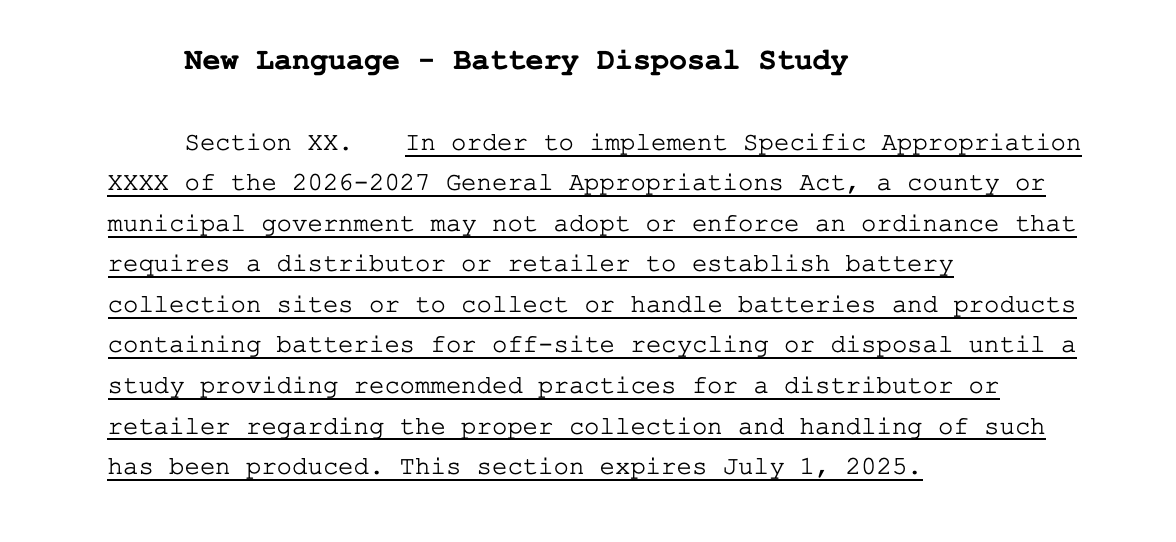
This is a familiar game in the Florida Legislature, where lawmakers have a history of using the budget to pass backdoor “preemptions” — a type of state law that takes power away from local governments — by allocating a bit of money for a fig-leaf study that can serve as a legal hook. Lawmakers have tried to use the same scheme in recent years to obstruct ordinances around everything from lawn fertilizer to gas-powered leaf blowers.
Broward County’s battery-recycling law was sponsored by Steve Geller, a county commissioner and former Democratic state senator from Hallandale Beach. It’s not clear who is lobbying the Legislature to undo it. But Geller told the South Florida Sun Sentinel that grocery store giant Publix Super Markets objected to a part of the ordinance that requires retailers to post signs notifying customers that the store will take their dead batteries.
“Publix — where garbage trucks catch on fire,” Geller told the Sun Sentinel.
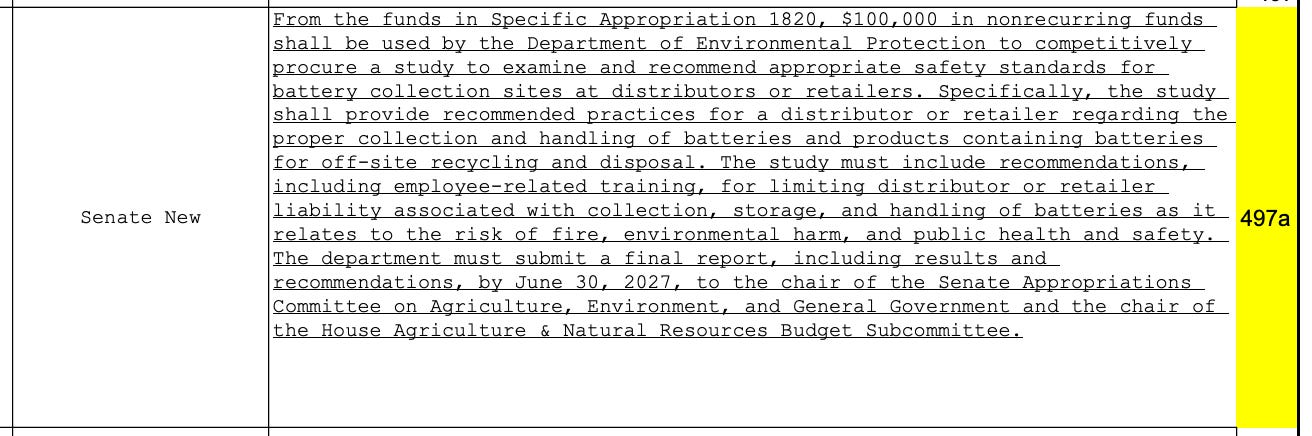
This latest preemption was pitched by the Florida Senate during the first round of what’s known as “budget conference,” the process by which budget negotiators in the House and Senate trade offers back and forth until they iron out every line item in the roughly $115 billion spending plan.
House leaders haven’t yet agreed to preempt local battery recycling programs. But they likely will before the conclusion of the budget special session, which is currently scheduled to end on May 29.
Here a few other notable developments from the first day of budget conference:
A new education earmark with lots of money — but little detail
Seemingly out of nowhere, House budget negotiators suddenly added a combined $110 million to their PreK-12 and higher education budgets for some kind of “Educational Support Grant Program.”
It’s hard to tell what exactly this is, because this program wasn’t in either chamber’s initial draft budget — and House leaders have so far been coy about the details.
A reporter asked Rep. Jenna Persons-Mulicka, a Republican from Fort Mayers who leads the House’s PreK-12 budget negotiating team, for an explanation after a conference meeting Tuesday. “I would describe that as an opportunity for further investment in our children,” Persons-Mulicka responded. “And stay tuned.”
Good news for the Ocklawaha River
Senators negotiating the agriculture and environment section of the budget dramatically increased recommended funding for restoration of the Ocklawaha River in central Florida, which has been blocked for more than half a century by an ill-conceived dam.
The Senate more than quadrupled proposed funding for the project, from $15 million to nearly $70 million. That was simultaneously odd and encouraging — considering Senate Republican leaders killed a bipartisan bill on the brink of passing earlier this year that would have revived the Ocklawaha, which is the largest tributary of the St. Johns River.
It still seems like an uphill battle. The House hasn’t yet agreed to any funding for Ocklawaha River restoration.
Sen. Jason Brodeur, a Republican from Sanford who leads the Senate’s agriculture and environment budget committee, told reporters after a meeting that he was trying to draw attention to the need for money ahead of an impending report from the Florida Department of Environmental Protection on the aging dam that impedes the Ocklawaha.
“We’re waiting on a report for DEP to receive that talks about some of the things that may need fixing at the dam. And so this is just a starting point for us,” Brodeur said.
“I don’t, candidly, expect us to end there,” he added. “But I want to make sure that there’s some acknowledgement that that could be a little bit of a risk…and that perhaps there’s an opportunity for us to — when that DEP report comes out — already have some money set aside in case there’s anything that’s in there.”
Bad news for sloths
On the other hand, the Senate’s agriculture and environment budget negotiators also slashed proposed funding for the Central Florida Zoo & Aquarium, where workers are racing to save a group of surviving sloths rescued from a failed Orlando tourist attraction where dozens of the beloved animals died.
The Sanford zoo took in 13 near-death sloths that had been poached from the wild to be displayed at the never-opened “Sloth World” in Orlando. The zoo is now spending at least $1,000 a day to care for the sloths — 10 of which are still alive, though several of those remain in critical condition. The zoo could end up spending as much as $200,000 on lab tests, medication and other care.
And yet the Senate cut funding for a major project at the zoo from $750,000 to $500,000. That money, records show, would help fund a modernization program across the 50-year-old facility, which needs to make upgrades in part to maintain accreditation with the Association of Zoos & Aquariums.
By dropping from $750,000 to $500,000, the Senate matched the House, suggesting that this particular line item could now be locked. But legislators always sprinkle some last-second money on a few favored projects just before the budget closes for good, so there may yet be hope for the sloths.
Storm clouds over the Rays
There was no Day 1 movement on state funding for a $2.3 billion baseball stadium for the Tampa Bay Rays.
That’s not necessarily a surprise. The controversial line item — $50 million, at least, for construction on the campus of Hillsborough College, where the Rays want to build their new ballpark — is likely to be one of the final issues resolved in the budget special session.
But what was surprising were the ominous comments from Sen. Ed Hooper, a Republican from Clearwater who is the Senate’s top budget negotiator. Hooper told reporters on Tuesday that the Legislature may not get involved at all until the billionaire-owned Rays get buy-in from Hillsborough County and the city of Tampa, which have been asked to kick in a whopping $1 billion of taxpayer cash toward the new stadium.
“It seems like they have some issues at the local level with their county and city request that may need to get resolved before the state contemplates involvement,” Hooper said. “There seems to be some heartburn at the request. And until they resolve that, I don’t think the state needs to be involved.”

We need independents or progressive Dems to run for office. In 2026, it's called democracy to have health care, food, housing, equal employment. It's not socialism - it's called being a modern society. You'll still have plenty of choices people - if you don't have money anyway, you'll never be able to have access to these universal basic needs anyway ~
The wealthy like their "socialism" in the Bahamas of course...
Publix does a good job of recycling plastics, foam, and paper, and they keep their stores clean and parking lots clear. Recycling batteries is different: Batteries can be dangerous to handle, some are potential fire hazards, and store drop-off points could become hazardous waste sites. I have to take old batteries to a municipal recycling site in west Jax or wait for a local site that opens for a weekend, twice a year (with long lines of cars.) I suspect many of our fellow citizens don't recycle their used batteries and they end up in the landfill or discarded in the environment. I support battery recycling one hundred percent but, in this case, putting the burden on retail outlets without paying them for their trouble seems unfair. Perhaps a disposal fee should be charged at the time of purchase to encourage recycling?