


This is Seeking Rents, a newsletter and podcast devoted to producing original journalism — and lifting up the work of others — about Florida politics, with an emphasis on the ways that big businesses and other special interests influence public policy in the state. Seeking Rents is produced by veteran investigative journalist Jason Garcia, and it is free to all. But please consider a voluntary paid subscription, if you can afford one, to help support our work. And check out our video channel, too.
Follow the Florida Legislature long enough and you’ll soon learn an important lesson:
Bills — especially those sought by special interests that spend lots of money cozying up to leaders in the state Capitol — rarely really die.
We got a reminder of that this week when Gov. Ron DeSantis quietly signed legislation that will make it easier for homebuilders to develop new subdivisions on farmland around cities.
Senate Bill 686 was known as the “agricultural enclaves” bill and it was pushed through the Legislature, at least in part, by corporate front groups like Associated Industries of Florida, the Florida Home Builders Association, the Florida Farm Bureau, and a lobbyist-invented outfit called the Alliance for Commercial Real Estate — which, records show, gave $10,000 to each of the bill sponsors shortly before session began. (The sponsors: Sen. Stan McClain, a Republican from Ocala, and Rep. Adam Botana, a Republican from Bonita Springs.)
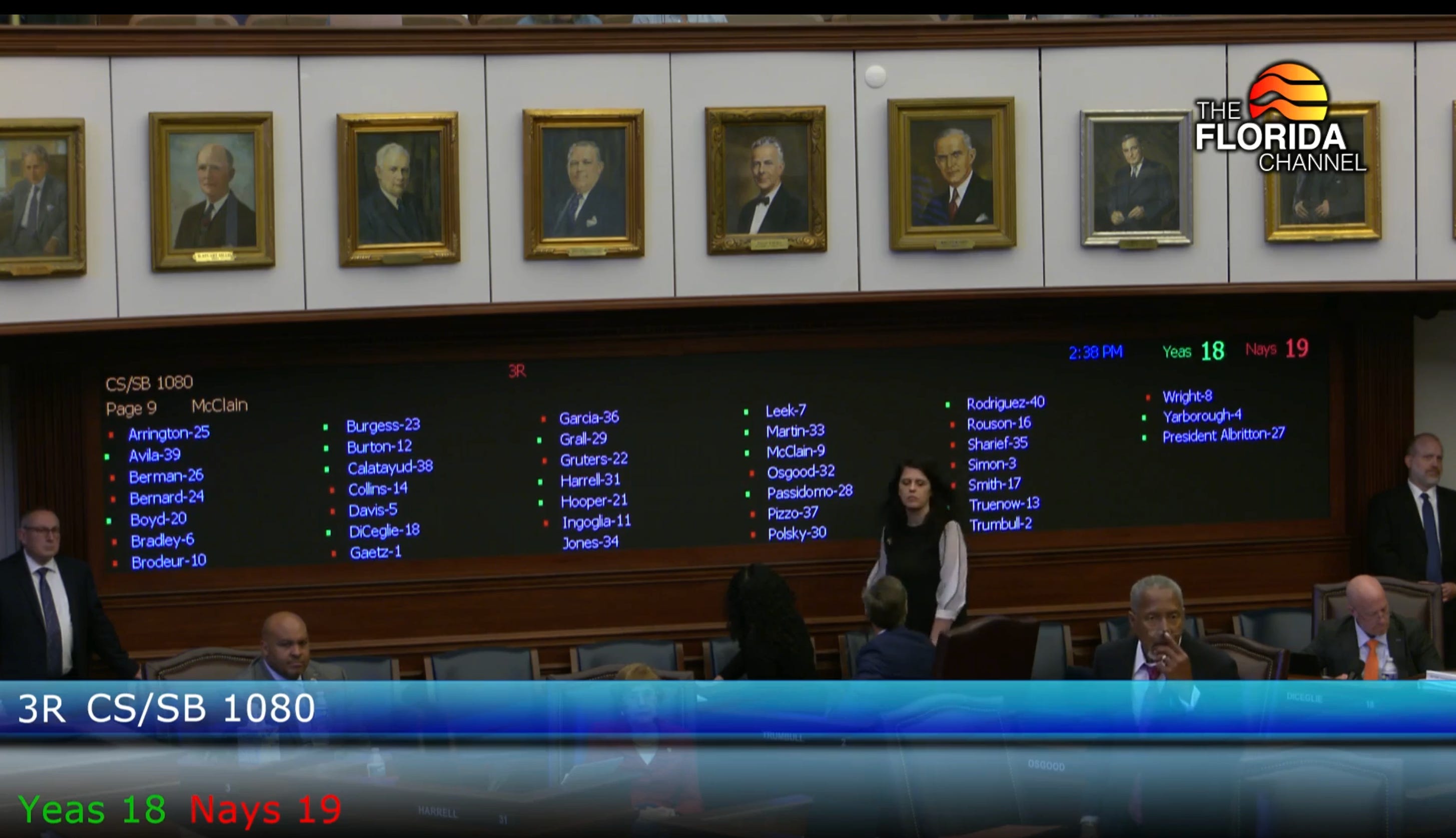
The legislation ultimately passed without much trouble. It cleared most of its committees unanimously, sailed through the Senate on a 34-2 vote, and breezed through the House of Representatives by a not-much-closer margin of 90-20.
Which is remarkable when you remember that this was one of the most controversial bills in Tallahassee a year ago.
A similar version of the agricultural enclaves legislation came close to passing during the 2025 session. But it was ultimately blocked by a bipartisan coalition of senators during a tense showdown on the Senate floor.
To be far, supporters made a few tweaks to the bill this time around to address some of the criticism they faced a year ago. Most significantly, the legislation now includes a provision meant to prevent a domino-like effect in which a series of neighboring farms, each more remote than the last, could get developed under the new rules one after another, accelerating suburban sprawl.
Still, a number of environmental groups remained opposed to the proposal, including 1000 Friends of Florida, Sierra Club and Friends of the Everglades.
More than anything else, boosters of the agricultural enclaves bill likely benefited from the fact that environmentalists, local governments, and slow-growth advocates had to spend so much of their time and attention this session fighting a new pro-developer plan: The so-called “Blue Ribbon Projects” bill, which would have enabled giant landowners to put city-sized developments on vast tracts of rural cattle ranches and timberlands without any meaningful local input.
The Blue Ribbon Projects bill came close to passing during the 2026 session. But it was ultimately blocked by a bipartisan coalition of senators during a tense showdown on the Senate floor.
Sound familiar?
Signing of the week
Senate Bill 686 — Agricultural Enclaves
To get a bit more granular about this bill, it basically does two main things.
First, it expands the types of properties that could qualify as “agricultural enclaves,” which are parcels that are mostly surrounded by either existing development or by land that has already been zoned for future development. A property designated as an enclave gains certain legal entitlements and streamlined development reviews that make the sites much more attractive to homebuilders.
Second, Senate Bill 686 also limits the discretion that county governments have to deny an agricultural enclave development for some reason.
But the new law is more than a little misleading.
An enclave is supposed to be kind of like an island. In fact, under the law as it existed before this year, an agricultural enclave had to be surrounded on at least 75 percent of its perimeter by existing development or land that has already been zoned for future development.

Senate Bill 626 lowers that threshold. Under the new law, some landowners will be able to get their properties qualified as agricultural enclaves — and gain the development leverage that come with it — if just 50 percent of their land is bordered by current or future development.

That’s not an enclave. That’s an edge.
What else did he sign?
Senate Bill 488 — Transportation
This began as a relatively mundane bill dealing with the state’s Department of Highway Safety and Motor Vehicles. But it was hijacked along the way by lobbyists for car dealers, the state-protected economic parasites who have been scuttling around the Capitol the last few years trying to make sure that Floridians can never buy new cars directly from electric-vehicle startups like Volkswagen-backed Scout Motors. The dealers’ latest legislation, which was attached to Senate Bill 488 late in the session, prevents car manufacturers who are launching a new brand from effectively sidestepping middleman dealers by allocating all new cars to a single super dealership that could also sell online.
Did he make a big deal of it? He did not. Ron DeSantis signed Senate Bill 488 without any public event on the same day the Legislature sent it to him.
Further reading: Is your license plate frame illegal? Florida lawmakers move to clear up confusion (Tampa Bay Times)
House Bill 441 — Conservation Lands
Inspired by the DeSantis administration’s secretive attempt last year to trade 600 acres of a beloved wilderness preserve to a mysterious developer, House Bill 441 will require more public notice before the state of Florida can sell or swap conservation land. It will also compel state officials to produce explanations detailing why the land they want to dispose of is no longer needed for conservation. This was genuinely one of the best bills of the session. And it was sponsored by the legislator — Rep. Kim Kendall, a Republican from St. Augustine — whose district includes the Guana River Wildlife Management Area, the wilderness preserve the DeSantis administration tried to pillage.
Did he make a big deal of it: Of course not. The entire legislation was a direct response to DeSantis’ own shady dealings. Not only did DeSantis sign this bill without any public fanfare, he did so on the same day he staged a big public ceremony to sign two other incendiary bills that he could be sure would attract lots of attention — and distract from any fresh stories about his failed land-swap scheme.
Further reading: Person posed as ‘60 Minutes’ producer to hunt for info on Florida land deal (Tampa Bay Times) ($)
House Bill 1217 — Prohibited Governmental Policies Regulating Greenhouse Gas Emissions
This is one of the two controversial bills that DeSantis signed on the same day as House Bill 441, and you could make a good argument that it should be the signing of the week. Straight out of a fossil fuel industry executive’s fantasy, House Bill 1217 strips city councils and county commissions across Florida of the power to pass local policies intended to reduce greenhouse gas emissions and combat climate change.
DeSantis and other supporters are framing it as a ban on carbon taxes, which are about as much of a threat in Florida as the non-existent windmills he banned a few years back. But the new law extends far beyond that and could potentially frustrate everything from electric vehicle procurement ordinances to energy conservation initiatives. If there’s a 2026 law that will cause Senate Bill 180-like consequences, this could well be it.
Did he make a big deal of it? He sure did. There wasn’t a podium poster for this press conference, but the governor did use the occasion to relive all his Covid-era culture war hits like the guy who peaked in high school.
Further reading: GOP lawmakers push to ban climate actions in FL cities; Dems fight to preserve them (Florida Trident)
Senate Bill 1134 — Official Actions of Local Governments
Yet another new Florida law aimed at stoking cultural resentments, Senate Bill 1134 forbids local governments from supporting diversity or inclusion programs aimed at helping historically excluded groups like Black and brown people, women, and LGBTQ+ communities.
The vaguely worded legislation — which, among other things, forbids cities and counties from promoting “activities designed or implemented with reference” to race, gender or sexual orientation — has prompted fears that it will lead local governments to avoid participating in all sorts of parades, festivals and other cultural celebrations. Especially since the new law also exposes local elected officials to risk of removal by the governor if he decides they have violated it.
Did he make a big deal of it? Of course. He signed this one at the same ceremony as House Bill 1217, pairing an anti-diversity law with an anti-climate change one — a slightly awkward fit, thematically, that hopefully explains the missing podium poster.
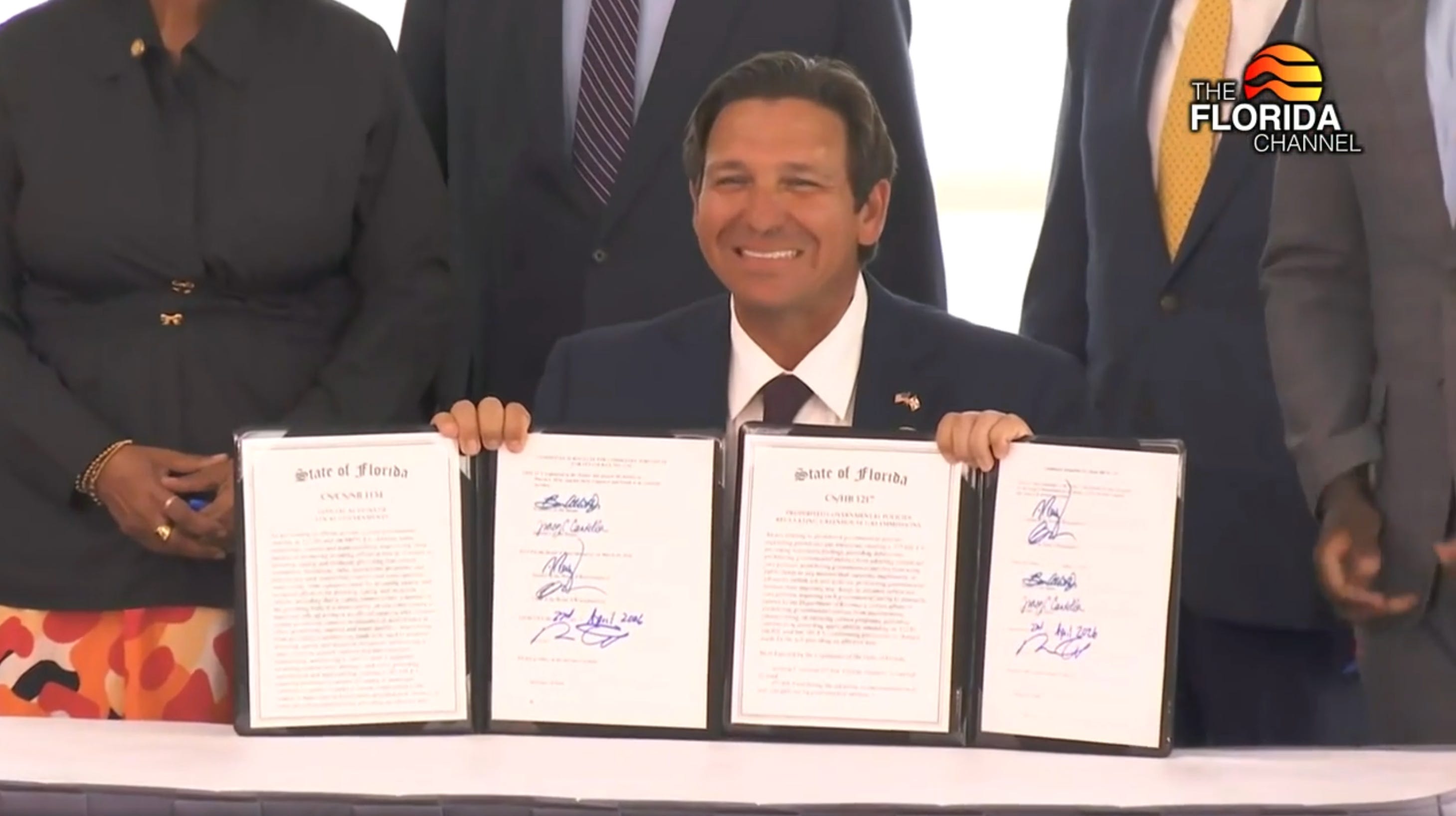
It should be noted that DeSantis wasn’t entirely devoid of solidarity when signing this bill. During his remarks, the governor urged the crowd to consider the discrimination faced by white men in America. “No. 1, obviously, would be white males,” the governor said while discussing those who is “disfavored” by diversity, equity and inclusion efforts. “I think they have been discriminated against.”
Further reading: Florida Passes Bill That Lets DeSantis Remove Local Elected Officials From Office For “Promoting” Pride (Erin In The Morning)
Senate Bill 182 — Education
A duck-billed platypus of an education package that was stitched together late in session. The most consequential piece of Senate Bill 182 allows small private schools to largely ignore local zoning and open up on any property approved for commercial development and inside retail stores, day cares, theaters and other businesses.
The new law also allows school districts to hire mentors to assist new or struggling teachers in poorly performing schools; requires elementary schools to teach kids cursive handwriting; and calls for the portraits of George Washington and Abraham Lincoln to be hung in every public school across the state.
Did he make a big deal of it? He didn’t. Apparently, George Washington and Abe Lincoln don’t merit a signing ceremony.
Further reading: Small private schools could open in commercially zoned buildings under late-session bill (Florida Phoenix)
And what did he veto?
Still nothing.
Previous editions
The DeSantis decisions: A Friday afternoon favor for the Fontainebleau
The DeSantis decisions: Singling out university students and hoping they’ll just stay home

Perhaps if Dee had played basketball or football he would have a greater appreciation for diversity.
This guy is in one lane. He can’t see beyond his little world and it is little. He ruined Florida . Don’t let him get near any government position!!!